Cyber Liability Insurance
PROTECT YOUR BUSINESS IN A DIGITAL WORLD.
BE READY BEFORE IT HAPPENS.
One cyber attack can shut down your operations, expose sensitive data, and damage your reputation. Tuve Insurance helps Minnesota and Iowa businesses manage cyber risks with comprehensive cyber liability insurance.
- Data Breach Response
- Business Email Compromise
- Business Interruption
- Ransomeware Protection
- Forensic Investigation
- Network & Privacy Liability
GET A QUICK QUOTE
it only takes a minute
Your information is secure and will never be shared
Protect Your Business from Data Breaches, Ransomware, and Online Threats
Technology enables Minnesota businesses to process payments, store records, and manage operations, but it also introduces cyber risks. Phishing, stolen passwords, ransomware, or accidental disclosures can compromise sensitive data and disrupt business. Cyber liability insurance helps organizations respond and manage financial impacts.
Tuve Insurance offers cyber liability insurance in Lakeville, MN, serving small businesses, contractors, retailers, and nonprofits statewide. As a veteran-owned independent agency, we help clients compare quotes and choose appropriate coverage. Call 952-469-0428 to discuss your cyber insurance needs.
What Is Cyber Liability Insurance?
Cyber liability insurance, also known as cyber insurance, data breach insurance, or cybersecurity insurance, helps businesses recover from technology-related incidents. Coverage may include data breaches, ransomware, network security failures, privacy violations, social engineering, business interruption, and cyber extortion.
Standard business owners or general liability policies often provide limited or no protection for cyber losses. Businesses typically need a separate cyber liability policy or a carefully reviewed cyber endorsement. Coverage varies by insurer, so compare limits, exclusions, deductibles, waiting periods, and security requirements.
What Does Cyber Insurance Cover?
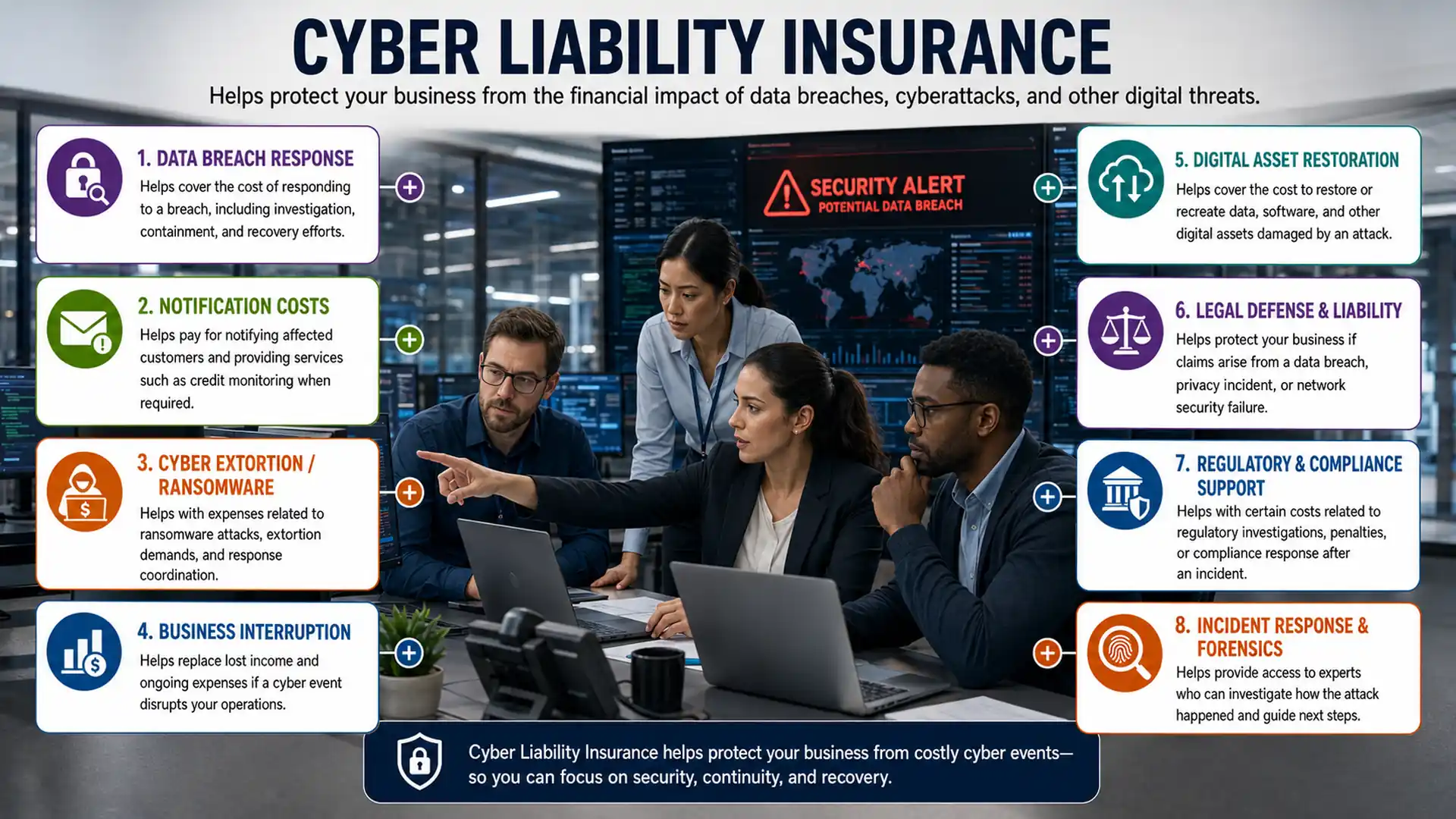
Cyber insurance typically includes first-party and third-party protection. First-party coverage helps your organization manage costs after a covered event. Third-party coverage helps defend your business against claims from customers, vendors, employees, or regulators.Data breach response coverage may pay for forensic investigations, legal guidance, customer notification, and credit monitoring.
Cyber extortion and ransomware coverage may help pay for investigation, negotiation, recovery, and certain ransom expenses. Policies may also provide access to breach-response professionals.Network security liability can help if a security failure leads to unauthorized access or malware transmission. Privacy liability may address allegations of improper collection, handling, storage, or disclosure of confidential information.
Business Interruption and Data Recovery
Cyberattacks can disrupt websites, payment systems, scheduling software, cloud applications, and networks. Cyber business interruption coverage may replace lost income and help pay ongoing expenses when a covered event interrupts operations.
Data restoration coverage may help recover or recreate electronic files, software, and systems. Some policies also include dependent business interruption coverage if a technology vendor or cloud provider experiences a covered outage that affects your business.
Review waiting periods carefully. Some policies only begin paying business interruption losses after an outage lasts a specified number of hours. The method for calculating lost income is also important.
Social Engineering and Funds Transfer Fraud
Cybercriminals often impersonate owners, executives, vendors, or customers, sending convincing emails that request wire transfers, payment changes, gift cards, or confidential information. These schemes are known as social engineering, phishing, or business email compromise.
Not all cyber liability policies automatically cover stolen funds. Social engineering fraud, computer fraud, and funds transfer fraud may require separate endorsements or sublimits. Ask how the policy responds if an employee is tricked into sending funds.Coverage should complement strong controls. Verification procedures, dual authorization, employee training, secure backups, multifactor authentication, and payment callbacks can reduce risk and improve insurance eligibility.
Who Needs Cyber Liability Insurance?
Any business that uses email, accepts electronic payments, stores customer information, maintains employee records, relies on cloud software, or operates a website faces cyber exposure. Small businesses are not immune; criminals may target them because they often have fewer security resources.
Cyber liability insurance is important for healthcare providers, accountants, attorneys, retailers, restaurants, contractors, manufacturers, nonprofits, and technology companies. Businesses handling Social Security numbers, health records, payment card data, financial information, or confidential client files should review their protection.
Vendors and commercial clients may require cyber insurance before signing a contract. Requirements can include minimum limits, privacy liability, network security coverage,
How Much Does Cyber Liability Insurance Cost in Minnesota?
The cost of cyber liability insurance in Minnesota depends on revenue, industry, number of records, security practices, coverage limits, deductibles, prior incidents, online sales, and reliance on technology. Insurers may ask about backups, multifactor authentication, endpoint protection, employee training, email security, patching, remote access, and incident response planning.
The lowest-cost cyber insurance policy may leave important gaps. Compare ransomware coverage, social engineering limits, business interruption terms, data restoration, regulatory defense, breach-response services, retroactive dates, and exclusions. A low premium has limited value if the policy does not address your risks.
Why Choose Tuve Insurance?
Tuve Insurance is a local, veteran-owned independent agency in Lakeville, Minnesota. We work with multiple carriers, enabling us to compare cyber liability insurance quotes and policy features instead of offering only one option.
We take time to understand your business, data, systems, vendors, contracts, and security controls. We coordinate cyber insurance with general liability, commercial property, business owner’s policies, professional liability, commercial auto, workers’ compensation, and umbrella coverage.
Request a Cyber Liability Insurance Quote
Cyber threats can affect businesses of any size, and recovery costs can escalate quickly. Do not wait until after a ransomware attack or data breach to learn what your insurance excludes. Contact Tuve Insurance for a cyber liability insurance review in Lakeville, MN.
Call Tuve Insurance at 952-469-0428 to request a Minnesota cyber insurance quote. We will help you compare coverage, identify potential gaps, and select protection tailored to your technology and operations.
Frequently Asked Questions
Cyber insurance is not generally required for all Minnesota businesses. However, lenders, vendors, clients, and contracts may require coverage. Even when optional, it can provide financial and response support after a cyber event.
Many cyber policies cover certain ransomware-related costs, subject to policy terms, exclusions, security requirements, deductibles, sublimits, and insurer approval. Coverage may include investigation, negotiation, data restoration, business interruption, and permitted extortion payments.
General liability insurance usually covers bodily injury, property damage, and certain advertising injuries. It may not cover privacy, network security, ransomware, notification, or data restoration expenses. A dedicated cyber policy is often needed.
The appropriate limit depends on revenue, record count, contractual requirements, regulatory exposure, technology dependence, and potential downtime. Many businesses consider $1 million in coverage, but some need higher limits or specialized endorsements.